Best Resistance Band for Rotator Cuff: Buyer's Guide (2026)
Rotator cuff strengthening is the gold-standard treatment for most shoulder pain. The right resistance band makes the program possible at home.
On this page
The rotator cuff is the most-injured muscle group in the body. About 30% of adults over 60 have rotator cuff tears (most asymptomatic). Most acute rotator cuff pain (impingement, tendinopathy, mild tears) responds to a 6-12 week strengthening program. Surgery is reserved for full-thickness tears, severe limitations, or failed conservative care.
Resistance bands are the right tool for rotator cuff rehab. The four small muscles (supraspinatus, infraspinatus, teres minor, subscapularis) need light, high-repetition resistance, not the kind of load you’d put on the larger shoulder muscles. Bands provide this precisely.
This guide helps you pick the right bands, learn the right exercises, and set realistic expectations for shoulder recovery.
Quick verdict
Top pick: Fit Simplify 5-Pack Loop Bands. Five resistance levels include the very-light grades needed for rotator cuff work. See our full review.
For traditional clinical approach: TheraBand resistance band set. Flat-sheet bands in graded colors, what most PTs use in clinic.
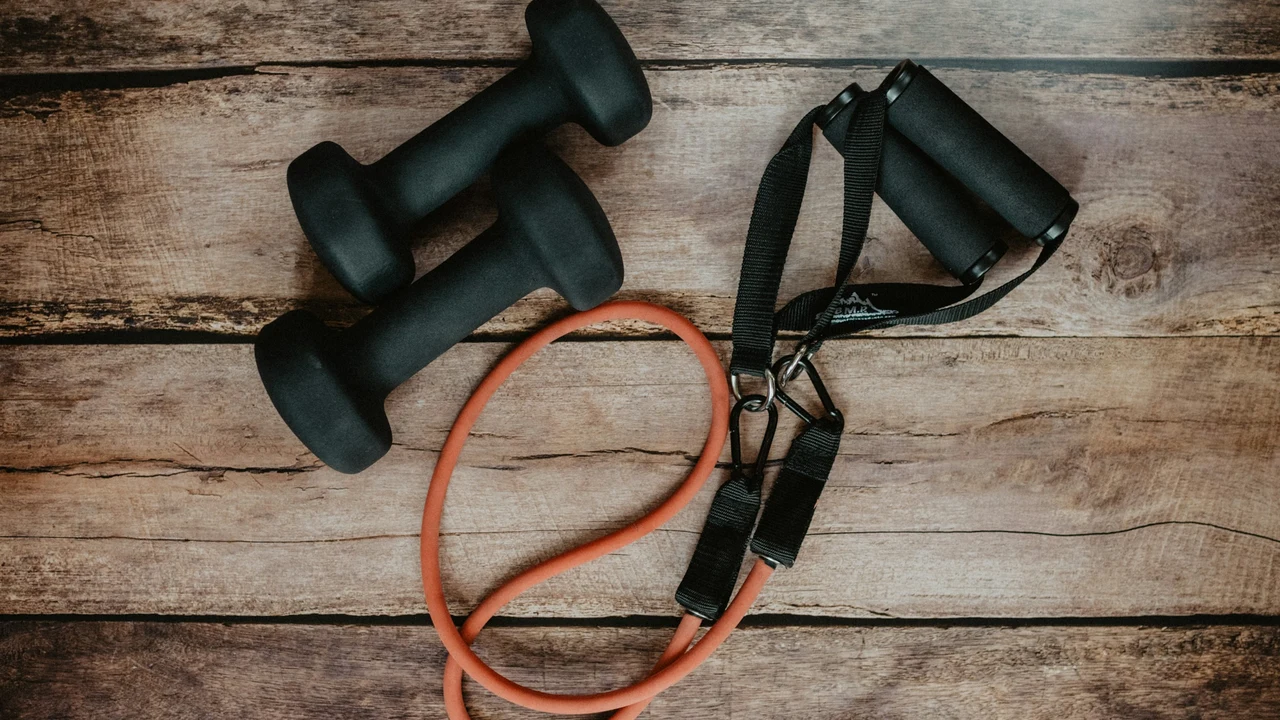
For door-anchor exercises: tube bands with handles + door anchor. Required for the external/internal rotation exercises that the rotator cuff specifically needs.
Don’t use: heavy bands. Rotator cuff work is high-rep, low-load. Heavy bands (black, blue, green in most sets) work the bigger muscles instead.
Why bands work for the rotator cuff
The rotator cuff muscles are small. The supraspinatus is about the size of a deck of cards. The infraspinatus is somewhat larger. None of them are designed to handle the kind of load that the deltoid, pec major, or lat dorsi handle.
Strengthening these small muscles requires:
- Light resistance (5-15 lbs equivalent)
- High repetitions (15-25 per set)
- Precise movement patterns (the muscles respond to specific angles)
- Slow concentric and eccentric phases
- Multiple sessions per week
Resistance bands deliver all of these. Free weights are clumsy at this load (1-3 lb dumbbells exist but feel awkward); cables and machines are gym-bound. Bands at home, used correctly, are the right tool.
The picks
Best overall: Fit Simplify 5-Pack Loop Bands
The Fit Simplify 5-pack includes a yellow band (lightest, around 2-3 lb equivalent) and a red band (around 5-7 lb equivalent). For rotator cuff work, these are the two you’ll use most. The black band is appropriate after 6-8 weeks of building strength.
The blue and green bands are too heavy for rotator cuff work; save them for hip and glute exercises.
For rotator cuff specifically: the loop format limits you to certain exercises. You can do banded scapular retractions (pull-aparts), banded shoulder external rotation (band around forearms with elbows at sides), and banded internal rotation (similar but pulling inward).
For the door-anchored exercises that are the rotator cuff gold standard (cable-style external/internal rotation), you need tube bands. See below.
Read our full Fit Simplify review.
Premium pick: TheraBand resistance band set
TheraBand is the clinical brand. PTs prescribe these by color (each color is a standard tension grade). The “yellow” TheraBand is genuinely lighter than the lightest in most consumer sets, which matters for post-surgical or acute-stage rotator cuff work.
The flat-sheet design is more versatile than loops for rotator cuff exercises. You can tie one end to a doorknob and hold the other end for cable-style exercises. You can grab the middle with both hands for pull-aparts. You can wrap around your forearm for rotation work.
Trade-offs: latex bands need replacement every 3-6 months with regular use. Cost adds up over time. For dedicated rotator cuff rehab programs, the versatility is worth it.
For door-anchor exercises: tube bands with handles
The canonical rotator cuff exercises are external and internal rotation against resistance. Done correctly:
-
External rotation: Elbow at your side, bent at 90 degrees, forearm parallel to floor. Pull resistance away from your body. This isolates the infraspinatus and teres minor.
-
Internal rotation: Same elbow position. Pull resistance across your body toward your stomach. This isolates the subscapularis.
These require resistance that comes from your side at elbow height. A loop band can’t provide this; you need a tube band anchored to a door at the right height. The door anchor accessory (included in most tube band sets) provides this.
Buy: a tube band set with handles plus a door anchor. Brands like Bodylastics, GoFit, or any reputable set work.
What to avoid: heavy bands for rotator cuff
The most common rotator cuff rehab error is using too much resistance. Heavy bands feel like they’re “doing more,” but they recruit the larger shoulder muscles instead of the small cuff muscles. The result: bigger muscles get stronger, the cuff doesn’t change.
Sign you’re using too much resistance:
- You feel the exercise in your upper trap (shrugging during the movement)
- You feel it in your deltoid (the side or front of the shoulder, not the back)
- Your elbow drifts away from your side during rotation
- You can do fewer than 12 reps with good form
If any of these happen, drop a grade.
The home rotator cuff program
This is the standard PT-prescribed home program for rotator cuff impingement, tendinopathy, and mild partial-thickness tears.
Phase 1: Activation (Weeks 1-2)
3-4 sessions per week, with at least 1 rest day between sessions.
- Banded pull-aparts. Yellow band, hold with both hands at chest level, pull apart while keeping arms straight. 2 sets of 15.
- Banded external rotation (loop band). Loop band around forearms, elbows at sides, slowly rotate forearms outward. 2 sets of 15.
- Wall slides. Back against wall, slide arms up and down maintaining contact between back and wall. 2 sets of 12.
- Scapular squeezes. Squeeze shoulder blades together, hold 5 seconds, release. 2 sets of 10.
Focus on form, not load. Use the yellow band even if it feels too easy. Slow, controlled movements with full range of motion.
Phase 2: Strengthening (Weeks 3-6)
3-4 sessions per week.
- Progress pull-aparts to red band.
- Banded external rotation (tube band, door anchor). Set door anchor at elbow height. Elbow at side, 90 degrees. Rotate forearm away from body. 3 sets of 15.
- Banded internal rotation (tube band, door anchor). Same setup. Rotate forearm across body. 3 sets of 15.
- Banded rows. Tube band anchored at chest height, pull elbows back, squeeze shoulder blades. 3 sets of 12.
- Face pulls. Tube band anchored at head height, pull toward face with elbows high. 3 sets of 12.
The external/internal rotation exercises are the core of the program. Don’t skip them.
Phase 3: Loading (Weeks 7-12)
3-4 sessions per week. Progress band tension as exercises feel easier.
- Maintain external/internal rotation work with progressively heavier bands.
- Add: banded shoulder press (light band, gentle pressing motion overhead). 2 sets of 12.
- Add: prone Y-T-W exercises (face down, arms in different positions, lift arms). 2 sets of 10 each position.
- Add: light pushups (against wall if needed, then incline, then floor as strength returns).
Return-to-Activity
After 8-12 weeks of consistent progression, most users can return to their pre-injury activities. The key is gradual: don’t go from rehab to full bench-pressing in one session. Add load and intensity over 2-4 weeks.
What rehab won’t do
Setting expectations:
- Won’t heal a full-thickness rotator cuff tear. Surgery may be needed; conservative care has limits.
- Won’t reverse calcific tendinopathy quickly. Crystals in the tendon take time and sometimes require additional intervention.
- Won’t address frozen shoulder. Adhesive capsulitis has its own protocol (mobility work, possibly steroid injection) different from rotator cuff strengthening.
- Won’t fix poor scapular mechanics in isolation. Scapular dyskinesis often coexists with rotator cuff issues and needs its own attention.
For these conditions, see a PT or orthopedist. Self-directed band exercise isn’t always the right starting point.
FAQ
How long does rotator cuff rehab take? 6-12 weeks for most cases of impingement and tendinopathy. Longer for partial tears (12-16 weeks). Surgical post-op recovery is 3-6 months minimum.
Should I do these exercises if my shoulder is currently painful? Light Phase 1 exercises with yellow band: yes for most acute pain (not severe). If exercises increase pain during or after, defer until pain reduces.
How do I know I’m using the right band tension? You should be able to complete 15-20 reps with good form, feeling moderate fatigue by the last few reps. If 15 reps feel trivial, go up a band. If you can’t reach 15 reps, drop a band.
Should I feel a stretch, a burn, or pain? Stretch: fine, particularly during the eccentric (returning) phase. Burn: fine, indicates muscle activation. Pain: stop, reduce intensity or modify the exercise.
Can I do these exercises during my regular workout? Yes. Rotator cuff work fits well into a warmup (before heavier lifting) or as accessory work after main exercises.
Do I need to do exercises for both shoulders if only one hurts? Yes. Bilateral exercises maintain symmetry and prevent the non-injured side from compensating. Often the non-injured side benefits from preventive strengthening too.
Will the bands fix my shoulder if it’s been hurting for years? Often yes, if the underlying cause is impingement or tendinopathy. Chronic shoulder pain that’s been present for years sometimes has more complex causes (significant arthritis, structural changes) where rehab alone is insufficient. A PT assessment is worthwhile.
How long can I use the same bands? Yellow and red bands typically last 3-6 months of regular use. Heavier bands (black, blue, green) last 12-24 months. Replace when they feel different (less tension, surface cracking).
Where to buy
The picks above link directly to Amazon with our affiliate tag.
For the deep review of the top pick, see Fit Simplify Loop Bands Review. For the broader category, see Best Resistance Bands of 2026.
Final word
For rotator cuff rehab, the right combination is the Fit Simplify 5-pack for general band work plus a tube band set with door anchor for the rotation exercises that the rotator cuff specifically needs. Total cost: under $50. Total program: 8-12 weeks for most cases.
Keep the tension light. Rotator cuff muscles are small; they don’t need heavy load. They need precise, controlled, high-repetition strengthening.
Add the rotation exercises (external and internal) to whatever else you’re doing for your shoulder. These are the highest-yield rotator cuff exercises and the most commonly skipped.
For shoulder pain that’s been present for more than 6 weeks without improvement, see a PT. Imaging may be warranted to rule out full-thickness tears or structural issues that don’t respond to rehab alone.
Not medical advice. We publish consumer product reviews; consult a licensed PT before changing your routine. We earn commissions on qualifying Amazon purchases.