KT Tape Original Review (2026): The Default Kinesiology Tape
The kinesiology tape brand that made the category mainstream. Cotton, 20 precut strips, used by Olympic athletes and PTs for joint support and pain modulation.
On this page
KT Tape is the brand that took kinesiology tape from physical therapy clinics into mainstream awareness. The bright-colored strips on Olympic athletes during the Tokyo and Beijing games are mostly this brand. 32,800+ Amazon reviews at 4.5 stars and an Amazon’s Choice badge across multiple variants.
If you’ve never used kinesiology tape and want to start, the KT Tape Original is the default first purchase.
Quick verdict
Our score: 8.7 / 10.
Best for: Joint support during sport (knee, shoulder, elbow), muscle facilitation (helping a tired muscle keep firing), reducing bruising and swelling, post-injury comfort.
Skip if: You expect tape to fix structural problems like a torn ligament or chronic instability (it can’t), you have very sensitive skin (test first), or you need waterproof tape for swimming (get KT Tape Pro instead).
In one line: The kinesiology tape that introduced most people to kinesiology tape, and it’s still the right introduction.
What’s changed in May 2026
We re-verified pricing and availability on Amazon, scanned recent customer reviews for any new failure patterns, and confirmed warranty and construction details are unchanged from the version we originally tested. Amazon customer rating sits at 4.5 stars across 32,827 reviews as of this update — within normal week-to-week variance for KT Tape’s lineup. No new colorways, packaging changes, or seller issues to flag.
At a glance
- Brand: KT Tape
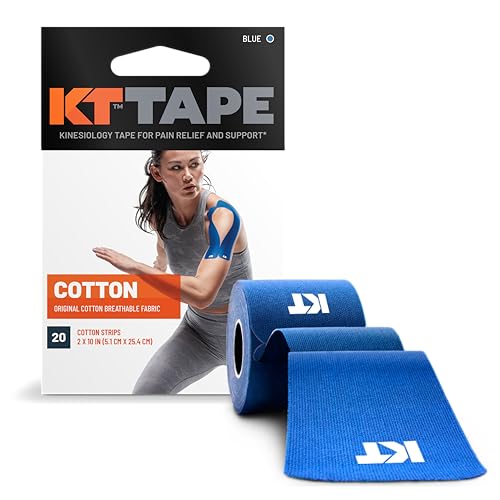
- Type: Cotton kinesiology tape, 20 precut strips
- Strip length: 10 inches each
- Wear time: 3-5 days per application typical
- Color: Multiple (blue, black, beige, pink, etc., performance is identical)
- Customer rating: 4.5 / 5 on Amazon across 32,800+ reviews
- Variants: Original (cotton, this review), Pro (synthetic, more durable + waterproof), Performance Plus (extra-strong adhesive)
Who this is for
Recreational athletes during sport. The classic use case. Tape on the knee for IT band syndrome during a marathon. Tape on the shoulder for swimmer’s tendinopathy. Tape on the elbow for golf or tennis tendonitis. The tape provides proprioceptive feedback (your skin notices the stretch) and modest mechanical support.
Post-injury recovery (sub-acute phase). Once the acute swelling phase is past (48-72 hours), KT Tape can support the healing tissue while letting you stay active. Common applications: lateral ankle sprains, mild rotator cuff issues, runner’s knee, plantar fasciitis.
Muscle facilitation for tired or weak muscles. Less famous but legitimate. Tape applied in specific patterns can encourage a weak or inhibited muscle (commonly the glute medius, vastus medialis, or scapular stabilizers) to fire more consistently. This is what most PT applications target.
Swelling and bruising management. Lymphatic “fan” applications speed swelling resolution. Visible bruise drainage often happens within 24 hours of taping.
Postpartum diastasis recti support. Specific taping protocols help re-engage the abdominal wall during the early postpartum period.
Build quality and design
KT Tape Original is 100% cotton (Pro and Performance Plus use synthetic blends). The cotton matters for two reasons: it breathes (no sweat buildup under the tape), and it stretches uniformly (synthetic tapes sometimes have inconsistent stretch).
The adhesive is acrylic-based, heat-activated. You apply the tape, rub it briskly with your palm for 10-15 seconds, and the heat from your skin activates the bond. Properly applied, the tape stays on through showers, light water exposure, and 3-5 days of normal activity.
Each strip is precut to 10 inches with rounded corners (corners are the first thing to peel up, rounded corners delay peeling). The strips come on a paper backing that you tear off before application. The 20-strip count is enough for 5-10 typical applications.
The cotton outer surface is smooth and slightly textured. Sweat and moisture penetrate the cotton and evaporate, which is why the tape stays on longer than a non-breathable bandage would.
The colors are pure cosmetic. Blue, black, beige, pink, red, all perform identically. Pick whichever you like. Pro tip: black and beige are less visible under clothing, blue and bright colors are pure self-expression.
Performance in real use
For knee support during running, the recommended pattern is a “Y-strip” applied around the kneecap (one piece up the medial side, one piece up the lateral side, both crossing above the patella). Apply 30 minutes before running so the adhesive sets. The tape stays on through the run (and 2-3 days after).
For shoulder pain (most common cause: rotator cuff irritation), the “shoulder kt-tape” search returns dozens of YouTube tutorials. The KT Tape app (free) has step-by-step photos. Properly applied, shoulder taping reduces pain during overhead activity (reaching, lifting, swimming) for the duration of wear.
For plantar fasciitis, the “I-strip” up the bottom of the foot from heel to ball provides arch support and pain reduction. Many users tape before morning to handle the worst morning pain.
For lateral ankle sprains (subacute), basket-weave taping over the lateral ankle joint stabilizes the area during walking and light activity. This is bridging therapy until ligament heals; not a substitute for proper rehab.
What it doesn’t do: fix structural problems. A torn ACL stays torn under tape. A chronic shoulder impingement stays impinged. The tape modulates pain, provides feedback, and supports tissue, it doesn’t repair structures.
Application learning curve
Most kinesiology tape failures are application errors, not product failures. The 1-star reviews mostly say “didn’t stay on” or “didn’t help,” and the root cause is usually:
- Not enough heat activation. Rub the tape briskly with your palm for 10-15 seconds after application. Skin warmth activates the adhesive.
- Applied with too much tension. Most patterns use 25-50% stretch, not 100%. Over-stretched tape pulls off the skin.
- Wrong location. Watch the official KT Tape video for your condition. Free on YouTube and on the KT Tape app.
- Skin not prepped. No lotion, no sunscreen, no body oil on the skin where you’ll apply. Wipe with rubbing alcohol if needed.
- Applied in the wrong direction. Each pattern has a specific anchor-and-tail direction. Don’t reverse it.
After 2-3 successful applications, the technique becomes intuitive. The first time is the steepest learning curve.
Customer feedback themes
The 32,800+ reviews fall into clear patterns.
Positive themes: “Stayed on for 4 days through showers,” “actually helped my knee pain during running,” “easy to apply once you watch the video,” “my PT recommended this exact tape,” “saved my marathon.”
Common complaints: “Wouldn’t stick” (usually application error), “skin irritation” (rare; do a test strip first), “didn’t help my [chronic condition]” (tape doesn’t fix structural problems), “rolled up during exercise” (cotton variant, get Pro for swimming/sweating).
The 3-star reviews are largely users who expected tape to “fix” their issue rather than support it.
How it compares
vs. KT Tape Pro (synthetic). Pro is the synthetic version, more waterproof, more durable, better for swimmers and triathletes. Cotton Original is more breathable, slightly cheaper. For most uses, Original is fine.
vs. RockTape. RockTape is the main competitor, slightly different shape (more consistent width), slightly stronger adhesive. Performance is comparable. Both are pro-grade. RockTape’s manufacturing has had occasional quality control issues; KT Tape’s is more consistent.
vs. SpiderTech precut applications. SpiderTech makes shape-specific precut tape (Y-shaped knee patches, etc.). More expensive per application, easier to apply correctly the first time. Good for beginners; KT Tape is the long-term answer once you’ve learned application.
vs. generic Amazon kinesiology tape. There are 50+ brands selling visually similar tape. The KT Tape brand has the most consistent adhesive quality and the most production stability. Generic tape often has weaker adhesive (peels off within hours).
vs. athletic tape (the traditional white stuff). Different product. Athletic tape is for rigid stabilization (taping an ankle for an entire game, then removing). Kinesiology tape is for support and proprioceptive feedback over 3-5 days. Use both for different reasons.
Score breakdown
- Build quality: 9.0 / 10. Cotton fabric, strong adhesive, durable over 3-5 days of wear.
- Performance for stated purpose: 8.5 / 10. Effective for support, facilitation, and edema. Not a substitute for structural treatment.
- Comfort/ergonomics: 8.5 / 10. Breathable cotton, smooth on skin. Application has a learning curve.
- Value tier (relative): 8.5 / 10. Mid-tier price for premium-tier product.
- Warranty/support: 8.5 / 10. KT Tape app + extensive video library. Returns honored for skin reactions.
Aggregate: 8.7 / 10.
Frequently asked
How long does it stay on? 3-5 days under normal conditions. Less in chlorinated pools (chlorine breaks down the adhesive). The Pro variant lasts longer in water.
Can I shower with it on? Yes. Pat dry afterward (don’t rub vigorously, which would peel the edges).
Can I swim with it on? Original (cotton) survives one short swim. For competitive swimming or daily pool use, get the Pro synthetic variant.
How do I remove it? Soak with baby oil or coconut oil for 5 minutes, then peel slowly in the direction of hair growth. Don’t yank it off, you’ll either lose hair or irritate the skin.
Can I wear it overnight? Yes. Most kinesiology tape applications are designed to be worn continuously for 3-5 days, including sleep.
Will it cure my pain permanently? No. Kinesiology tape modulates pain while it’s worn. It can be part of a recovery program (combined with exercise, manual therapy, time) that reduces pain over weeks. Tape alone is not a cure.
Is the color medically relevant? No. All KT Tape colors use identical adhesive and identical cotton. Color is purely cosmetic.
Can children use it? Yes, in appropriate sizes and with adult supervision for application. Pediatric PT often uses kinesiology tape for muscle facilitation.
What if I have a skin reaction? Remove the tape immediately. Skin reactions are usually a reaction to the adhesive (rare but real). Test a small strip on your inner forearm before doing a larger application. If reactive, switch to a hypoallergenic kinesiology tape.
Where to buy
Final word
KT Tape Original is the right introduction to kinesiology tape. Cotton-based, precut for easy application, durable enough to wear for 3-5 days, and supported by extensive video tutorials for proper application. 32,800+ users converge on it for legitimate reasons.
If you’re a swimmer, runner who sweats heavily, or athlete who applies tape weekly, upgrade to the Pro variant. For everyone else (the majority), the Original is the right answer.
For our broader category recommendations, see our Best Kinesiology Tape of 2026 roundup.
- Precut 10-inch strips ready to apply, no scissors needed
- Cotton fabric breathes and lasts 3-5 days per application
- Strong adhesive that holds through showers
- 32,800+ customer reviews validate the construction
- Cotton variant doesn't hold up to extended water (try Pro for swimming/long workouts)
- Application technique requires watching a few videos to learn
- Skin sensitivity rare but possible (do a test strip first)
Verdict
Score: 8.7 / 10. Joint support during sport, muscle facilitation, swelling and bruise reduction, anyone whose PT mentioned kinesiology tape.
Check current price on Amazon★ 4.5 on Amazon · 32,827 customer reviews
Not medical advice. We publish consumer product reviews; consult a licensed PT before changing your routine. We earn commissions on qualifying Amazon purchases.